Solve the following system of equations.
\begin{equation*}
\begin{array}{ccccccccc}
x \amp + \amp 2y\amp -\amp 3z\amp = \amp 1 \\
-5x\amp +\amp 2y\amp -\amp 3z\amp =\amp 1\\
x\amp - \amp 2y\amp +\amp z\amp =\amp 1
\end{array}
\end{equation*}
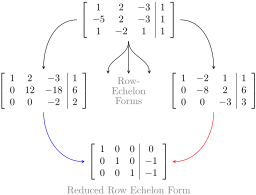
We create an augmented matrix corresponding to the system and apply row operations until the matrix is in row echelon form.
\begin{equation*}
\left[\begin{array}{ccc|c}
1\amp 2\amp -3\amp 1\\-5\amp 2\amp -3\amp 1\\1\amp -2\amp 1\amp 1
\end{array}\right]
\begin{array}{c}
\\
\xrightarrow{R_2+5R_1}\\
\xrightarrow{R_3-R_1}\\
\end{array}
\left[\begin{array}{ccc|c}
1\amp 2\amp -3\amp 1\\0\amp 12\amp -18\amp 6\\0\amp -4\amp 4\amp 0
\end{array}\right]
\begin{array}{c}
\\
\\
\xrightarrow{R_3+\frac{1}{3}R_2}\\
\end{array}
\end{equation*}
\begin{equation}
\left[\begin{array}{ccc|c}
1\amp 2\amp -3\amp 1\\0\amp 12\amp -18\amp 6\\0\amp 0\amp -2\amp 2
\end{array}\right]\tag{1.2.1}
\end{equation}
Note that the elementary row operations that lead to
(1.2.1) were not prescribed. We may employ row-operations in a different manner and obtain a different matrix in row echelon form. For example, suppose for some reason we had begun by switching the first and third rows.
\begin{equation*}
\left[\begin{array}{ccc|c}
1\amp 2\amp -3\amp 1\\-5\amp 2\amp -3\amp 1\\1\amp -2\amp 1\amp 1
\end{array}\right]
\begin{array}{c}
\\
\xrightarrow{R_1\leftrightarrow R_3}\\
\\
\end{array}
\left[\begin{array}{ccc|c}
1\amp -2\amp 1\amp 1\\-5\amp 2\amp -3\amp 1\\1\amp 2\amp -3\amp 1
\end{array}\right]
\begin{array}{c}
\\
\\
\\
\end{array}
\end{equation*}
Next we would reduce this matrix to row echelon form, perhaps in this way:
\begin{equation*}
\left[\begin{array}{ccc|c}
1\amp -2\amp 1\amp 1\\-5\amp 2\amp -3\amp 1\\1\amp 2\amp -3\amp 1
\end{array}\right]
\begin{array}{c}
\\
\xrightarrow{R_2+5R_1}\\
\xrightarrow{R_3-R_1}\\
\end{array}
\left[\begin{array}{ccc|c}
1\amp -2\amp 1\amp 1\\0\amp -8\amp 2\amp 6\\0\amp 4\amp -4\amp 0
\end{array}\right]
\begin{array}{c}
\\
\\
\xrightarrow{R_3+\frac{1}{2}R_2}\\
\end{array}
\end{equation*}
\begin{equation}
\left[\begin{array}{ccc|c}
1\amp -2\amp 1\amp 1\\0\amp -8\amp 2\amp 6\\0\amp 0\amp -3\amp 3
\end{array}\right]\tag{1.2.2}
\end{equation}
The augmented matrices in
(1.2.1) and
(1.2.2) are clearly not the same, but both are in row echelon form. If we write the systems of equations corresponding to
(1.2.1) and
(1.2.2), we can employ back substitution to solve them. The matrix in
(1.2.1) corresponds to
\begin{equation*}
\begin{array}{ccccccccc}
x \amp + \amp 2y\amp -\amp 3z\amp = \amp 1 \\
\amp \amp 12y\amp -\amp 18z\amp =\amp 6\\
\amp \amp \amp \amp -2z\amp =\amp 2
\end{array}
\end{equation*}
The matrix in
(1.2.2) corresponds to
\begin{equation*}
\begin{array}{ccccccccc}
x \amp - \amp 2y\amp +\amp z\amp = \amp 1 \\
\amp \amp -8y\amp +\amp 2z\amp =\amp 6\\
\amp \amp \amp \amp -3z\amp =\amp 3
\end{array}
\end{equation*}
Because both systems are equivalent to the original system, it is not surprising that back substitution yields the same solution for both systems.
\begin{equation*}
x=0,\quad y=-1,\quad z=-1
\end{equation*}
\begin{equation*}
x=0, y=-1, z=-1
\end{equation*}
\begin{equation*}
x=0, y=-1, z=-1
\end{equation*}