Subsection 2.5.1 Functions from \(\R^n\) into \(\R^m\)
In the past you have worked with functions \(f:\R\longrightarrow \R\text{.}\) Most of the time such functions were defined algebraically. For example, we can define \(f\) by
\begin{equation*}
f(x)=x^2.
\end{equation*}
To fix our notation, we now define functions formally, along with some closely related terms.
Definition 2.5.2.
Let \(V\) and \(W\) be sets. A function \(f\) from \(V\) into \(W\text{,}\) denoted by
\begin{equation*}
f:V\rightarrow W
\end{equation*}
assigns to each element \(x\) of \(V\text{,}\) an element \(y=f(x)\) of \(W\text{.}\) Moreover, we use the the following terminology.
The set \(V\) is called the domain of \(f\text{,}\) and the set \(W\) is called the codomain.
If \(y=f(x)\text{,}\) we say that \(x\) maps to \(y\text{,}\) and \(y\) is the image of \(x\text{.}\)
Given some subset of \(V\text{,}\) call it \(X\text{,}\) we define the image of the subset \(X\) to be the set of \(f(x)\) for exactly those \(x\) in the subset \(X\text{.}\) The set \(f(V)\) is called the image or range of the function \(f\)
For our example function \(f(x)=x^2\) above, the domain and codomain are both \(\R\) and the image of the subset of real numbers less than -5 is the set of real numbers greater than 25. In symbols,
\begin{equation*}
f(\{ x : x \lt -5 \}) = \{ y : y \gt 25 \}.
\end{equation*}
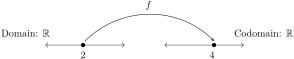
Previously, you might have visualized function like \(f(x)=x^2\) by looking at its graph, the set of all points of the form \((x, f(x))\) in \(\R^2\text{.}\) In this course, we will find it more useful to look at functions diagrammatically. For instance, the diagram below shows that \(f\) maps 2 to 4. We say that 4 is the image of 2 under \(f\).
We will now consider functions that map \(\R^n\) into \(\R^m\text{.}\) We will refer to such functions as transformations. There are two ways of thinking of transformations.
A transformation \(T:\R^n\longrightarrow\R^m\) can take a vector in \(\R^n\) and map it to a vector in \(\R^m\text{,}\) or it can map a point in \(\R^n\) to a point in \(\R^m\text{.}\) We think of transformations as acting on vectors or points interchangeably because every point
\begin{equation*}
(x_1, x_2,\dots ,x_n) \ \text{ in} \R^n
\end{equation*}
can be interpreted as the tip of a vector
\begin{equation*}
[x_1, x_2, \ldots , x_n] \ \text{in } \R^n.
\end{equation*}
Matrix multiplication will provide us with initial tools for defining some transformations.
Subsection 2.5.4 Columns and the standard basis
In this section we will look at the images of standard unit vectors under a matrix transformation, and discuss why this information is helpful.
Exploration 2.5.2.
Let \(A=\begin{bmatrix}1\amp 2\amp 3\\4\amp 5\amp 6\\7\amp 8\amp 9\end{bmatrix}\text{.}\)
Problem 2.5.6.
Find the following products:
\begin{equation*}
\begin{bmatrix}1\amp 2\amp 3\\4\amp 5\amp 6\\7\amp 8\amp 9\end{bmatrix}\begin{bmatrix}1\\0\\0\end{bmatrix}.
\end{equation*}
\begin{equation*}
\begin{bmatrix}1\amp 2\amp 3\\4\amp 5\amp 6\\7\amp 8\amp 9\end{bmatrix}\begin{bmatrix}0\\1\\0\end{bmatrix}.
\end{equation*}
\begin{equation*}
\begin{bmatrix}1\amp 2\amp 3\\4\amp 5\amp 6\\7\amp 8\amp 9\end{bmatrix}\begin{bmatrix}0\\0\\1\end{bmatrix}.
\end{equation*}
Answer.
\begin{equation*}
\begin{bmatrix}1\amp 2\amp 3\\4\amp 5\amp 6\\7\amp 8\amp 9\end{bmatrix}\begin{bmatrix}1\\0\\0\end{bmatrix}=\begin{bmatrix}1\\4\\7\end{bmatrix}
\end{equation*}
\begin{equation*}
\begin{bmatrix}1\amp 2\amp 3\\4\amp 5\amp 6\\7\amp 8\amp 9\end{bmatrix}\begin{bmatrix}0\\1\\0\end{bmatrix}=\begin{bmatrix}2\\5\\8\end{bmatrix}
\end{equation*}
\begin{equation*}
\begin{bmatrix}1\amp 2\amp 3\\4\amp 5\amp 6\\7\amp 8\amp 9\end{bmatrix}\begin{bmatrix}0\\0\\1\end{bmatrix}=\begin{bmatrix}3\\6\\9\end{bmatrix}
\end{equation*}
Let \(T:\R^3\longrightarrow\R^3\) be a matrix transformation induced by \(A\text{,}\) then we can say that \(T\) maps \(\mathbf{i}\text{,}\) \(\mathbf{j}\) and \(\mathbf{k}\) to the first, second and third columns of \(A\text{,}\) respectively. This nice property is not limited to transformations induced by square matrices. Let \(T:\R^3\rightarrow \R^2\) be a linear transformation induced by
\begin{equation*}
A=\begin{bmatrix}1\amp -2\amp 4\\0\amp 3\amp 5\end{bmatrix}
\end{equation*}
Problem 2.5.7.
We will examine the effect of \(T\) on the standard unit vectors \(\mathbf{i}\text{,}\) \(\mathbf{j}\) and \(\mathbf{k}\text{.}\) Try and compute
\begin{equation*}
T(\mathbf{i})=A\mathbf{i} \quad \text{and} \quad T(\mathbf{k})=A\mathbf{k}.
\end{equation*}
Answer.
\begin{equation*}
T(\mathbf{i})=A\mathbf{i}=\begin{bmatrix}1\\0\end{bmatrix},\quad T(\mathbf{j})=A\mathbf{j}=\begin{bmatrix}-2\\3\end{bmatrix}, \quad
T(\mathbf{k})=A\mathbf{k}=\begin{bmatrix}4\\5\end{bmatrix}
\end{equation*}
Observe that the image of \(\mathbf{i}\) is the first column of \(A\text{,}\) the image of \(\mathbf{j}\) is the second column of \(A\text{,}\) and the image of \(\mathbf{k}\) is the third column.
Why is it that knowing the images of standard unit vectors under a matrix transformation is helpful? Consider the following example.
Example 2.5.9.
Let \(T:\R^2\longrightarrow\R^2\) be a matrix transformation such that
\begin{equation*}
T(\mathbf{i})=\begin{bmatrix}-2\\3\end{bmatrix} \ \text{ and } \
T(\mathbf{j})=\begin{bmatrix}1\\0\end{bmatrix}.
\end{equation*}
Find \(T\left(\begin{bmatrix}-4\\10\end{bmatrix}\right)\text{.}\)
Now,
Example 2.5.9 illustrates that a matrix transformation
\(T:\R^n\longrightarrow\R^m\) is
completely determined by where it maps the standard unit vectors. This is true because we can express every vector
\(\mathbf{v}\) in
\(\R^n\) as a linear combination of the standard unit vectors, then use
(2.5.3) and
(2.5.4) to find the image of
\(\mathbf{v}\text{.}\)
Recall in
Section 2.3 we defined the identity matrix
\(I_n\) as the
\(n\times n\) matrix whose
\(j^{th}\) column is the standard unit vector
\(\mathbf{e}_j\text{.}\) The identity matrix induces a matrix transformation
\(T:\R^n\longrightarrow\R^n\) such that
\(T(\mathbf{e}_j)=\mathbf{e}_j\) for all
\(j=1,\ldots,n\text{.}\) This transformation maps every vector in
\(\R^n\) to itself. For this reason, we call it the
identity transformation.
Example 2.5.10.
Let \(T:\R^3\longrightarrow\R^3\) be the identity transformation, defined by \(T(\mathbf{x})=I_3\mathbf{x}\text{.}\) Find \(T\left(\begin{bmatrix}1\\2\\3\end{bmatrix}\right)\text{.}\)
Answer.
Observe:
\begin{align*}
T\left(\begin{bmatrix}1\\2\\3\end{bmatrix}\right) \amp =
\begin{bmatrix}
1\amp 0\amp 0\\
0\amp 1\amp 0\\
0\amp 0\amp 1
\end{bmatrix}
\begin{bmatrix}1\\2\\3\end{bmatrix}\\
\amp = 1\begin{bmatrix}1\\0\\0\end{bmatrix}
+ 2\begin{bmatrix}0\\1\\0\end{bmatrix}
+ 3\begin{bmatrix}0\\0\\1\end{bmatrix}\\
\amp = \begin{bmatrix}1\\2\\3\end{bmatrix}.
\end{align*}