Exploration 2.6.1.
In this exercise we will introduce a very special type of transformation by contrasting the effects of two transformations on vectors of \(\R^2\text{.}\) We will see that some transformations have ``nice" properties, while others do not. Define \(T_1\) and \(T_2\) as follows:
\begin{equation*}
T_1:\R^2\rightarrow\R^2; \quad T_1\left(\begin{bmatrix}
x\\
y
\end{bmatrix}\right)=\begin{bmatrix}
x-y\\
x
\end{bmatrix},
\end{equation*}
\begin{equation*}
T_2:\R^2\rightarrow\R^2; \quad T_2\left(\begin{bmatrix}
x\\
y
\end{bmatrix}\right)=\begin{bmatrix}
-x+y+1\\
y-2
\end{bmatrix}.
\end{equation*}
Each of these transformations takes a vector in \(\R^2\text{,}\) and maps it to another vector in \(\R^2\text{.}\) To see if you understand how these transformations are defined, see if you can determine what these transformations do to the vector \([4,3]\text{.}\)
Problem 2.6.1.
Compute the following two images:
\begin{equation*}
T_1\left(\begin{bmatrix}
4\\
3
\end{bmatrix}\right) \quad \text{and} \quad
T_2\left(\begin{bmatrix}
4\\
3
\end{bmatrix}\right)
\end{equation*}
Answer.
\begin{equation*}
T_1\left(\begin{bmatrix}
4\\
3
\end{bmatrix}\right)=\begin{bmatrix}
1\\
4
\end{bmatrix} \quad \text{and} \quad
T_2\left(\begin{bmatrix}
4\\
3
\end{bmatrix}\right)=\begin{bmatrix}
0\\
1\end{bmatrix}.
\end{equation*}
Now, let’s take the vector \([4,3]\) and multiply it by a scalar, say \(7\text{.}\)
\begin{equation*}
7\begin{bmatrix}
4\\
3
\end{bmatrix} = \begin{bmatrix}
28\\
21
\end{bmatrix}.
\end{equation*}
Now let’s compare how \(T_1\) and \(T_2\) ``handle" this product. Starting with \(T_1\text{,}\) we compute:
\begin{equation*}
T_1\left(7\begin{bmatrix}
4\\
3
\end{bmatrix}\right)=T_1\left(\begin{bmatrix}
28\\
21
\end{bmatrix}\right)=\begin{bmatrix}
7\\
28
\end{bmatrix}.
\end{equation*}
Observe that multiplying the original vector by \(7\text{,}\) then applying \(T_1\text{,}\) has the same effect as applying \(T_1\) to the original vector, then multiplying the image by \(7\text{.}\) In other words,
\begin{equation*}
T_1\left(7\begin{bmatrix}
4\\
3
\end{bmatrix}\right)=\begin{bmatrix}
7\\
28
\end{bmatrix}=7\begin{bmatrix}
1\\
4
\end{bmatrix}=7T_1\left(\begin{bmatrix}
4\\
3
\end{bmatrix}\right).
\end{equation*}
Diagrammatically, this can be represented as follows.
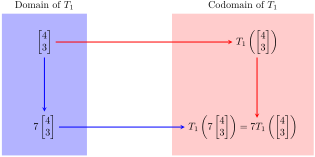
In this diagram, the vectical arrows are the operation of scalar multiplication by \(7\) and the horizontal arrows are the operation of applying the linear transformation \(T\text{.}\) What the diagram tells us is, whether we multiply by \(7\) and then apply \(T\) or we apply \(T\) and then multiply by \(7\text{,}\) either way gives us the same output.
You should verify that this property does not hold for transformation \(T_2\text{.}\) In other words,
\begin{equation*}
T_2\left(7\begin{bmatrix}
4\\
3
\end{bmatrix}\right)\neq 7T_2\left(\begin{bmatrix}
4\\
3
\end{bmatrix}\right).
\end{equation*}
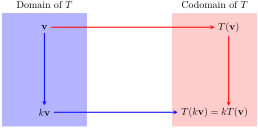
There is nothing special about the number \(7\text{,}\) and it is not hard to prove that for any scalar \(k\) and vector \(\mathbf{u}\) of \(\R^2\text{,}\) \(T_1\) satisfies
\begin{equation}
kT_1(\mathbf{u})= T_1(k\mathbf{u}).\tag{2.6.1}
\end{equation}
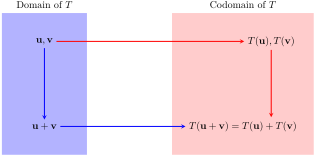
It turns out that \(T_1\) satisfies another important property. For all vectors \(\mathbf{u}\) and \(\mathbf{v}\) of \(\R^2\) we have:
\begin{equation}
T_1(\mathbf{u}+\mathbf{v}) = T_1(\mathbf{u})+T_1(\mathbf{v})\tag{2.6.2}
\end{equation}
We leave it to the reader to illustrate this property with a specific example (see Exercise 2.6.4.1). We will show that \(T_1\) satisfies (2.6.2) in general. Let
\begin{equation*}
\mathbf{u}=\begin{bmatrix}
u_1\\
u_2
\end{bmatrix} \quad \text{and } \mathbf{v}=\begin{bmatrix}
v_1\\
v_2
\end{bmatrix}.
\end{equation*}
then
\begin{align*}
T_1(\mathbf{u}+\mathbf{v})\amp =T_1\left(\begin{bmatrix}
u_1\\
u_2
\end{bmatrix}+\begin{bmatrix}
v_1\\
v_2
\end{bmatrix}\right) \\
\amp =T_1\left(\begin{bmatrix}
u_1+v_1\\
u_2+v_2
\end{bmatrix}\right) \\
\amp =\begin{bmatrix}
u_1+v_1-u_2-v_2\\
u_1+v_1
\end{bmatrix} \\
\amp =\begin{bmatrix}
u_1-u_2\\
u_1
\end{bmatrix}+\begin{bmatrix}
v_1-v_2\\
v_1
\end{bmatrix} \\
\amp=T_1\left(\begin{bmatrix}
u_1\\
u_2
\end{bmatrix}\right)+T_1\left(\begin{bmatrix}
v_1\\
v_2
\end{bmatrix}\right) \\
\amp =T_1(\mathbf{u})+T_1(\mathbf{v}).
\end{align*}
It turns out that \(T_2\) fails to satisfy this property. Can you prove that this is the case? Remember that to prove that a property does not hold, it suffices to find a counter-example. See if you can find vectors \(\mathbf{u}\) and \(\mathbf{v}\) such that
\begin{equation}
T_2(\mathbf{u}+\mathbf{v}) \neq T_2(\mathbf{u})+T_2(\mathbf{v}).\tag{2.6.3}
\end{equation}
See Exercise 2.6.4.2 for more on this.