Exploration 6.1.1.
Let
\begin{equation*}
A=\begin{bmatrix} 2\amp 1\\ 1\amp 2\end{bmatrix}.
\end{equation*}
The following animation helps us to visualize the matrix transformation associated with \(A\text{.}\) Given a vector \(\mathbf{x}\) in \(\R^2\text{,}\) its image, \(A\mathbf{x}\text{,}\) is also in \(\R^2\text{.}\) Set slider to \(0\) to see input vectors \(\mathbf{x}\text{;}\) change it to \(1\) see their images \(A\mathbf{x}\text{.}\)
1
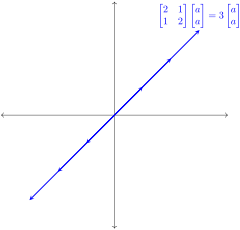
geogebra.orgFor many vectors, \(A\mathbf{x}\) does not point in the same direction as \(\mathbf{x}\text{.}\) This is the case for all of the gray vectors in the animation, as we can see that \(A\mathbf{x}\) points in a different direction than \(\mathbf{x}\text{.}\) But if we look at the red vectors (vectors parallel to \([-1,1]\)), we notice that they appear unchanged in magnitude and direction. Such vectors are sometimes called fixed vectors of \(A\text{.}\) Looking next at the blue vectors (vectors parallel to \([1,1]\)), we observe that the magnitudes of the vectors are changed, but the direction in which the blue vectors point is unchanged by this linear transformation.