Logo image

Coordinated Linear Algebra

Section 2.2 Linear Combination Equations and Span

When studying vectors, the two main operations we have learned about are vector addition and scalar multiplication. Both are involved in the important concept of a linear combination of vectors.

Definition 2.2.1.

A vector \(\mathbf{v}\) is said to be a linear combination of vectors \(\mathbf{v}_1, \mathbf{v}_2,\ldots, \mathbf{v}_n\) if
\begin{equation*} a_1\mathbf{v}_1+ a_2\mathbf{v}_2+\ldots + a_n\mathbf{v}_n = \mathbf{v} \end{equation*}
for some scalars \(a_1, a_2, \ldots ,a_n\text{.}\)
For example, \(\begin{bmatrix} -4\\9\\-10\\-1\end{bmatrix}\) is a linear combination of \(\begin{bmatrix} -1\\3\\-3\\0\end{bmatrix}\text{,}\) \(\begin{bmatrix} 2\\0\\1\\4\end{bmatrix}\) and \(\begin{bmatrix} 0\\1\\-1\\1\end{bmatrix}\) because
\begin{equation*} \begin{bmatrix} -4\\9\\-10\\-1\end{bmatrix}=2\begin{bmatrix} -1\\3\\-3\\0\end{bmatrix}+(-1)\begin{bmatrix} 2\\0\\1\\4\end{bmatrix}+3\begin{bmatrix} 0\\1\\-1\\1\end{bmatrix} \end{equation*}

Remark 2.2.2.

Moving forward, vectors will also be written in horizontal notation instead of vertical. This is mainly for notational reasons. For instance, the vector
\begin{equation*} \begin{bmatrix} -4\\9\\-10\\-1\end{bmatrix} \end{equation*}
would instead in midtext be denoted by \([-4,9,10,-1]\text{.}\) This is justified, as any point in \((a,b,c,d)\) in \(\R^4 \) can be thought of as the vector starting from the orign \((0,0,0,0) \) and with direction \([a,b,c,d] \text{.}\)

Subsection 2.2.1 Visualizing Linear Combinations in \(\R^2\) and \(\R^3\)

Exploration 2.2.1.

Answer the questions below using the GeoGebra interactive. To use the interactive, you can
  1. change vectors \(\mathbf{v}\) and \(\mathbf{w}\) by dragging the tips of these vectors.
  2. change the coefficients \(k_1\) and \(k_2\) of the linear combination by using sliders.
Figure 2.2.3.
Problem 2.2.4.
Let \(\mathbf{w}=[1,2]\) and \(\mathbf{v}=[1,-1]\text{.}\) Find \(k_1\) and \(k_2\) such that
\begin{equation*} k_1\mathbf{w}+k_2\mathbf{v}=\begin{bmatrix}4\\-1\end{bmatrix}. \end{equation*}
Answer.
\(k_1=1,\quad k_2=3.\)
Problem 2.2.5.
Let \(\mathbf{w}=[1,2]\) and \(\mathbf{v}=[-2,0]\text{.}\) Find \(k_1\) and \(k_2\) such that
\begin{equation*} k_1\mathbf{w}+k_2\mathbf{v}=[3,-2]. \end{equation*}
Answer.
\(k_1=-1,\quad k_2=-2 \)
Problem 2.2.6.
Use the same vectors \(\mathbf{w}\) and \(\mathbf{v}\) as in the previous part. Do you think it is possible to express any vector in \(\R^2\) as a linear combination of \(\mathbf{w}\) and \(\mathbf{v}\text{?}\)
Answer.
\begin{equation*} \text{Yes} \end{equation*}
Problem 2.2.7.
Let \(\mathbf{w}=[4, 2]\) and \(\mathbf{v}=[-2,-1]\text{.}\) Do you think it is possible to express any vector in \(\R^2\) as a linear combination of \(\mathbf{w}\) and \(\mathbf{v}\text{.}\) Argue why/why not and write?
Answer.
\begin{equation*} \text{No} \end{equation*}
Visualizing linear combinations of vectors in \(\R^3\) is more difficult than doing so in \(\R^2\text{.}\) The following GeoGebra interactive will help you do this.

Exploration 2.2.2.

To use the interactive, define vectors \(\mathbf{u}\text{,}\) \(\mathbf{v}\) and \(\mathbf{w}\text{.}\) Use sliders to change the coefficients \(k_1, k_2\) and \(k_3\) of the linear combination. The linear combination \(k_1\mathbf{u}+k_2\mathbf{v}+k_3\mathbf{w}\) is shown as the pink vector along the diagonal of the parallelepiped. RIGHT-CLICK and DRAG the left panel to rotate the image.
Figure 2.2.8.

Subsection 2.2.2 Solving Linear Combination Equations

A linear combination equation is an equation of the form
\begin{equation*} x_1\mathbf{v}_1+x_2\mathbf{v}_2+\ldots + x_n\mathbf{v}_n=\mathbf{b} \end{equation*}
where \(\mathbf{v}_1, \mathbf{v}_2, \ldots, \mathbf{v}_n\) and \(\mathbf{b}\) are vectors in \(\R^m\text{,}\) and \(x_1, x_2, \ldots, x_n\) are unknowns.

Exploration 2.2.3.

Express \(\begin{bmatrix}3\\ -4\end{bmatrix}\) as a linear combination of \(\begin{bmatrix}-1\\ 3\end{bmatrix}\) and \(\begin{bmatrix}-4\\ 2\end{bmatrix}\) or determine if it is not possible.
Answer.
We need to solve for scalars \(x_1\) and \(x_2\) such that
\begin{equation*} x_1\begin{bmatrix}-1\\3\end{bmatrix}+x_2\begin{bmatrix}-4\\2\end{bmatrix}=\begin{bmatrix}3\\-4\end{bmatrix}. \end{equation*}
Simplifying the left-hand side, we get the equation
\begin{equation*} \begin{bmatrix}-x_1-4x_2\\3x_1+2x_2\end{bmatrix}=\begin{bmatrix}3\\-4\end{bmatrix}. \end{equation*}
This gives us the system of equations
\begin{equation*} \begin{array}{ccc} -x_1-4x_2 \amp = \amp 3 \\ 3x_1+2x_2 \amp = \amp -4 \end{array}. \end{equation*}
Now we solve the system by row reducing the corresponding augmented matrix:
\begin{align*} \left[\begin{array}{cc|c} -1 \amp -4 \amp 3 \\ 3 \amp 2 \amp -4 \end{array}\right] \amp \xrightarrow{R_2+3R_1} \left[\begin{array}{cc|c} -1 \amp -4 \amp 3 \\ 0 \amp -10 \amp 5 \end{array}\right]\\ \amp \xrightarrow[-\frac{1}{10}R_2]{(-1)R_1} \left[\begin{array}{cc|c} 1 \amp 4 \amp -3 \\ 0 \amp 1 \amp -\frac{1}{2} \end{array}\right]\\ \amp \xrightarrow{R_1-4R_2} \left[\begin{array}{cc|c} 1 \amp 0 \amp -1 \\ 0 \amp 1 \amp -\frac{1}{2} \end{array}\right] \end{align*}
Hence, the solution to the system is \(x_1 = -1\) and \(x_2 = -\frac{1}{2}\text{,}\) and we can express \(\begin{bmatrix}3\\-4\end{bmatrix}\) as a linear combination of \(\begin{bmatrix}-1\\3\end{bmatrix}\) and \(\begin{bmatrix}-4\\2\end{bmatrix}\) as follows:
\begin{equation*} \begin{bmatrix}3\\-4\end{bmatrix} = -1\begin{bmatrix}-1\\3\end{bmatrix} + \left(-\frac{1}{2}\right)\begin{bmatrix}-4\\2\end{bmatrix}. \end{equation*}
To solve the linear combination equation in Exploration 2.2.3, we reinterpreted it as a system of linear equations. In general, the linear combination equation
\begin{equation} x_1 \begin{bmatrix}a_{11}\\a_{12}\\\vdots\\a_{1m}\end{bmatrix} + x_2 \begin{bmatrix}a_{21}\\a_{22}\\\vdots\\a_{2m}\end{bmatrix} + \cdots + x_n \begin{bmatrix}a_{n1}\\a_{n2}\\\vdots\\a_{nm}\end{bmatrix} = \begin{bmatrix}b_1\\b_2\\\vdots\\b_m\end{bmatrix}\tag{2.2.1} \end{equation}
corresponds to the system of equations
\begin{equation*} \begin{array}{ccccccccc} a_{11}x_1 \amp + \amp a_{12}x_2 \amp + \cdots + \amp a_{1n}x_n\amp = \amp b_1 \\ a_{21}x_1 \amp + \amp a_{22}x_2 \amp + \cdots + \amp a_{2n}x_n\amp = \amp b_2 \\ \amp \amp \amp \vdots \amp \amp \amp \\ a_{m1}x_1 \amp + \amp a_{m2}x_2 \amp + \cdots + \amp a_{mn}x_n\amp = \amp b_m \end{array}. \end{equation*}
Hence, to solve the linear combination equation (2.2.1), we can row reduce the augmented matrix
\begin{equation*} \left[\begin{array}{cccc|c} a_{11} \amp a_{12} \amp \ldots \amp a_{1n} \amp b_1\\ a_{21} \amp a_{22} \amp \ldots \amp a_{2n} \amp b_2\\ \amp \amp \vdots \amp \amp \vdots\\ a_{m1} \amp a_{m2} \amp \ldots \amp a_{mn} \amp b_m \end{array}\right]. \end{equation*}
The resulting row echelon form will give us the solution to the linear combination equation. If the system is consistent, then
\begin{equation*} \mathbf{b} = \begin{bmatrix}b_1\\b_2\\\vdots\\b_m\end{bmatrix} \end{equation*}
is a linear combination of the vectors
\begin{equation*} \mathbf{v}_1 = \begin{bmatrix}a_{11}\\a_{12}\\\vdots\\a_{1m}\end{bmatrix}, \mathbf{v}_2 = \begin{bmatrix}a_{21}\\a_{22}\\\vdots\\a_{2m}\end{bmatrix}, \ldots, \mathbf{v}_n = \begin{bmatrix}a_{n1}\\a_{n2}\\\vdots\\a_{nm}\end{bmatrix}. \end{equation*}
If the system is inconsistent, then \(\mathbf{b}\) is not a linear combination of the vectors \(\mathbf{v}_1, \mathbf{v}_2, \ldots, \mathbf{v}_n\text{.}\)

Example 2.2.9.

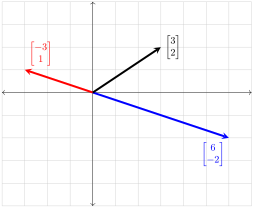
Can the vector \([3,2]\) be written as a linear combination of vectors \([-3,1]\) and \([6,-2]\text{?}\)
Answer.
We will start with a geometric approach.
Three vectors drawn
Observe that \([-3,1]\) and \([6,-2]\) are scalar multiples of each other and lie on the same line. A linear combination of \([-3,1]\) and \([6,-2]\) has the form:
\begin{equation*} a\begin{bmatrix}6\\-2\end{bmatrix}+b\begin{bmatrix}-3\\1\end{bmatrix}=a(-2)\begin{bmatrix}-3\\1\end{bmatrix}+b\begin{bmatrix}-3\\1\end{bmatrix}=(-2a+b)\begin{bmatrix}-3\\1\end{bmatrix}. \end{equation*}
This shows that all linear combinations of \([-3,1]\) and \([6,-2]\) will be scalar multiples of \([-3,1]\text{,}\) and therefore lie on the same line as \([-3,1]\text{.}\) Since \([3,2]\) does not lie on the line determined by \([-3,1]\) it cannot be expressed as a linear combination of \([-3,1]\) and \([6,-2]\text{.}\)
We can also address this question algebraically. To express \([3,2]\) as a linear combination of \([-3,1]\) and \([6,-2]\text{,}\) we need to solve the equation.
\begin{equation*} a\begin{bmatrix}-3\\1\end{bmatrix}+b\begin{bmatrix}6\\-2\end{bmatrix}=\begin{bmatrix}3\\2\end{bmatrix} \end{equation*}
This corresponds to the system of equations
\begin{align*} -3a + 6b \amp = 3 \\ a - 2b \amp = 2 \end{align*}
and augmented matrix
\begin{equation*} \left[\begin{array}{cc|c} -3 \amp 6 \amp 3 \\ 1 \amp -2 \amp 2 \end{array}\right]. \end{equation*}
Let’s row reduce this matrix to see if the system is consistent:
\begin{align*} \left[\begin{array}{cc|c} -3 \amp 6 \amp 3 \\ 1 \amp -2 \amp 2 \end{array}\right] \amp \xrightarrow{R_1\leftrightarrow R_2} \left[\begin{array}{cc|c} 1 \amp -2 \amp 2 \\ -3 \amp 6 \amp 3 \end{array}\right]\\ \amp \xrightarrow{R_2+3R_1} \left[\begin{array}{cc|c} 1 \amp -2 \amp 2 \\ 0 \amp 0 \amp 9 \end{array}\right] \end{align*}
As we reduce the augmented matrix, notice that there is a pivot in the last column. This means the system is inconsistent, and therefore \([3,2]\) cannot be written as a linear combination of \([-3,1]\) and \([6,-2]\text{.}\)

Example 2.2.10.

Express \([2,4]\) as a linear combination of \([2,1]\) and \([2,-2]\text{.}\) Interpret your results geometrically.
Answer.
We need to find scalars \(x_1\) and \(x_2\) such that
\begin{equation*} x_1 \begin{bmatrix} 2\\ 1 \end{bmatrix} + x_2 \begin{bmatrix} 2\\ -2 \end{bmatrix} = \begin{bmatrix} 2\\ 4\end{bmatrix}. \end{equation*}
Write down the augmented matrix for this equation and row reduce:
\begin{align*} \begin{bmatrix}2 \amp 2 \amp 2\\ 1 \amp -2 \amp 4\end{bmatrix} \amp \xrightarrow{\frac{1}{2}R_1} \begin{bmatrix}1 \amp 1 \amp 1\\ 1 \amp -2 \amp 4\end{bmatrix} \xrightarrow{R_2 - R_1} \begin{bmatrix}1 \amp 1 \amp 1\\ 0 \amp -3 \amp 3\end{bmatrix}\\ \amp \xrightarrow{-\frac{1}{3}R_2} \begin{bmatrix}1 \amp 1 \amp 1\\ 0 \amp 1 \amp -1\end{bmatrix} \xrightarrow{R_1 - R_2} \begin{bmatrix}1 \amp 0 \amp 2\\ 0 \amp 1 \amp 1\end{bmatrix} \end{align*}
Hence, \(x_1=2\) and \(x_2=-1\text{.}\) Now we can write \([2,4]\) as a linear combination of \([2,1]\) and \([2,-2]\) as follows:
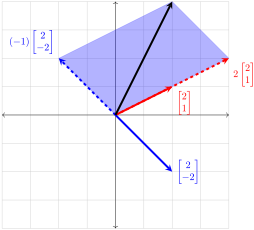
\begin{equation*} \begin{bmatrix}2\\4\end{bmatrix}=2\begin{bmatrix}2\\1\end{bmatrix}+(-1)\begin{bmatrix}2\\-2\end{bmatrix}. \end{equation*}
Geometrically, this means that the vector \([2,4]\) is the diagonal of the parallelogram determined by \(2[2,1]\) and \((-1) [2,-2]\text{.}\)
The original vectors \([2,1]\) and \([2,-2]\) are shown below together with the parallelogram and its diagonal.
Paralellogram with diagonal drawn

Example 2.2.11.

If possible, express \([7, 4, -5]\) as a linear combination of \([1,-2,1]\) and \([3, 0, -1]\text{.}\)
Answer.
We are looking for coefficients \(x_1\) and \(x_2\) such that
\begin{equation*} x_1\begin{bmatrix}1\\-2\\1\end{bmatrix} + x_2\begin{bmatrix}3\\0\\-1\end{bmatrix} = \begin{bmatrix}7\\4\\-5\end{bmatrix}. \end{equation*}
This translates into the system of linear equations
\begin{align*} x_1+3x_2 \amp = 7 \\ -2x_1 \amp = 4 \\ x_1 - x_2 \amp = -5 \end{align*}
Solving this system for \(x_1\) and \(x_2\) yields \(x_1=-2\) and \(x_2=3\text{.}\) We conclude that \([7,4,-5]\) is a linear combination of \([1,-2,1]\) and \([3,0,-1]\text{.}\) Specifically, we have
\begin{equation*} -2\begin{bmatrix}1\\-2\\1\end{bmatrix}+3\begin{bmatrix}3\\0\\-1\end{bmatrix} = \begin{bmatrix}7\\4\\-5\end{bmatrix}. \end{equation*}

Example 2.2.12.

Set up a system of equations that can be used to express \([2,-1,3,0]\) as a linear combination of \([1,0,4,-2]\text{,}\) \([-2,-1,1,-1]\text{,}\) \([0,4,-3,1]\) and \([1,1,-1,4]\text{,}\) or to determine that such a combination does not exist.
\(\textbf{Do not solve the system}. \)
Answer.
We are looking for \(x_1\text{,}\) \(x_2\text{,}\) \(x_3\) and \(x_4\) such that
\begin{equation*} x_1\begin{bmatrix}1\\0\\4\\-2\end{bmatrix}+x_2\begin{bmatrix}-2\\-1\\1\\-1\end{bmatrix}+x_3\begin{bmatrix}0\\4\\-3\\1\end{bmatrix}+x_4\begin{bmatrix}1\\1\\-1\\4\end{bmatrix}=\begin{bmatrix}2\\-1\\3\\0\end{bmatrix}. \end{equation*}
This translates into the following system of equations:
\begin{equation*} \begin{array}{ccccccccc} x_1 \amp -\amp 2x_2 \amp \amp \amp + \amp x_4\amp = \amp 2 \\ \amp \amp -x_2 \amp + \amp 4x_3 \amp +\amp x_4\amp = \amp -1 \\ 4x_1 \amp + \amp x_2 \amp -\amp 3x_3 \amp -\amp x_4\amp = \amp 3\\ -2x_1\amp -\amp x_2 \amp +\amp x_3\amp +\amp 4x_4\amp =\amp 0 \end{array}. \end{equation*}

Subsection 2.2.3 The Linear Span

Recall that a vector \(\mathbf{v}\) is said to be a linear combination of vectors \(\mathbf{v}_1, \mathbf{v}_2,\ldots, \mathbf{v}_n\) if one has
\begin{equation*} a_1\mathbf{v}_1+ a_2\mathbf{v}_2+\ldots + a_n\mathbf{v}_n = \mathbf{v} \end{equation*}
for some scalars \(a_1, a_2, \ldots ,a_n\text{.}\) Let’s look at an explicit example to demystify this notion.

Example 2.2.13.

If possible, express the vectors
\begin{equation*} \mathbf{u}=\begin{bmatrix}2\\3\\5\end{bmatrix} \quad \text{and} \quad \mathbf{w}=\begin{bmatrix}5\\5\\1\end{bmatrix} \end{equation*}
as a linear combination of
\begin{equation*} \mathbf{v}_1=\begin{bmatrix}-2\\-3\\4\end{bmatrix},\quad\mathbf{v}_2=\begin{bmatrix}2\\3\\2\end{bmatrix}. \end{equation*}
Interpret your results geometrically.
Answer.
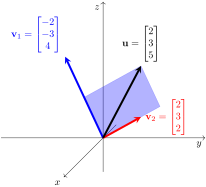
For \(\mathbf{u}\text{,}\) we need to find coefficients \(a_1\) and \(a_2\) such that \(a_1\mathbf{v}_1+a_2\mathbf{v}_2=\mathbf{u}\text{.}\) To do this we need to solve the linear combination equation:
\begin{equation*} a_1\begin{bmatrix}-2\\-3\\4\end{bmatrix}+a_2\begin{bmatrix}2\\3\\2\end{bmatrix}=\begin{bmatrix}2\\3\\5\end{bmatrix}. \end{equation*}
Now we write the corresponding augmented matrix and reduce it to reduced row echelon form.
\begin{equation*} \left[\begin{array}{cc|c} -2\amp 2\amp 2\\-3\amp 3\amp 3\\4\amp 2\amp 5 \end{array}\right] \xrightarrow{\text{RREF}} \left[\begin{array}{cc|c} 1\amp 0\amp 1/2\\0\amp 1\amp 3/2\\0\amp 0\amp 0 \end{array}\right]. \end{equation*}
Hence, \(a_1=\frac{1}{2}\text{,}\) \(a_2=\frac{3}{2}\text{,}\) and we can express \(\mathbf{u}\) as a linear combination of \(\mathbf{v}_1\) and \(\mathbf{v}_2\) as follows:
\begin{equation*} \frac{1}{2}\begin{bmatrix}-2\\-3\\4\end{bmatrix}+\frac{3}{2}\begin{bmatrix}2\\3\\2\end{bmatrix}=\begin{bmatrix}2\\3\\5\end{bmatrix}. \end{equation*}
Observe that because vector \(\mathbf{u}\) is a linear combination of \(\mathbf{v}_1\) and \(\mathbf{v}_2\text{,}\) \(\mathbf{u}\) is the diagonal of a parallelogram whose sides are scalar multiples of \(\mathbf{v}_1\) and \(\mathbf{v}_2\text{.}\) As such, \(\mathbf{u}\) lies in the same plane as \(\mathbf{v}_1\) and \(\mathbf{v}_2\text{,}\) as illustrated below.
Span of two vectors graphed
For \(\mathbf{w}\text{,}\) we need to solve the following vector equation:
\begin{equation*} a_1\begin{bmatrix}-2\\-3\\4\end{bmatrix}+a_2\begin{bmatrix}2\\3\\2\end{bmatrix}=\begin{bmatrix}5\\5\\1\end{bmatrix}. \end{equation*}
Writing the equation in augmented matrix form and applying elementary row operations gives us the following reduced row echelon form:
\begin{equation*} \left[\begin{array}{cc|c} -2\amp 2\amp 5\\-3\amp 3\amp 5\\4\amp 2\amp 1 \end{array}\right] \xrightarrow{\text{RREF}} \left[\begin{array}{cc|c} 1\amp 0\amp 0\\0\amp 1\amp 0\\0\amp 0\amp 1 \end{array}\right]. \end{equation*}
We conclude that there are no solutions, and \(\mathbf{w}\) is not a linear combination of \(\mathbf{v}_1\) and \(\mathbf{v}_2\text{.}\)
Geometrically, this means that \(\mathbf{w}\) is not the diagonal of any parallelogram whose sides are scalar multiples of \(\mathbf{v}_1\) and \(\mathbf{v}_2\text{.}\) Thus, \(\mathbf{w}\) does not lie in the plane determined by \(\mathbf{v}_1\) and \(\mathbf{v}_2\text{.}\)
Three vectors graphed without span
In Example 2.2.13 we expressed \(\mathbf{u}\) as a linear combination of \(\mathbf{v}_1\) and \(\mathbf{v}_2\text{,}\) and concluded that \(\mathbf{u}\) lies in the plane determined by \(\mathbf{v}_1\) and \(\mathbf{v}_2\text{.}\) We say that \(\mathbf{u}\) is in the span of \(\mathbf{v}_1\) and \(\mathbf{v}_2\text{.}\) In fact, every vector in the plane determined by \(\mathbf{v}_1\) and \(\mathbf{v}_2\) is in the span of \(\mathbf{v}_1\) and \(\mathbf{v}_2\text{.}\) We say that \(\mathbf{v}_1\) and \(\mathbf{v}_2\) span the plane.
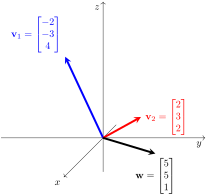
In contrast, vector \(\mathbf{w}\) of Example 2.2.13 is not a linear combination of \(\mathbf{v}_1\) and \(\mathbf{v}_2\text{.}\) So, we say \(\mathbf{w}\) is not in the span of \(\mathbf{v}_1\) and \(\mathbf{v}_2\text{.}\)
The following video takes another look at Example 2.2.13 using our new vocabulary.

Definition 2.2.14.

Let \(\mathbf{v}_1, \mathbf{v}_2,\ldots ,\mathbf{v}_p\) be vectors in \(\R^n\text{.}\) The set \(S\) of all linear combinations of \(\mathbf{v}_1, \mathbf{v}_2,\ldots ,\mathbf{v}_p\) is called the span of \(\mathbf{v}_1, \mathbf{v}_2,\ldots ,\mathbf{v}_p\text{.}\) We write
\begin{equation*} S=\text{span}(\mathbf{v}_1, \mathbf{v}_2,\ldots ,\mathbf{v}_p), \end{equation*}
and we say that vectors \(\mathbf{v}_1, \mathbf{v}_2,\ldots ,\mathbf{v}_p\) span \(S\text{.}\) Any vector in \(S\) is said to be in the span of \(\mathbf{v}_1, \mathbf{v}_2,\ldots ,\mathbf{v}_p\text{.}\) The set \(\{\mathbf{v}_1, \mathbf{v}_2,\ldots ,\mathbf{v}_p\}\) is called a spanning set for the space \(S\text{.}\)
The definition is rather formal even with all the preceding examples and geometric intuition. We highly recommend Working through the examples below in detail.

Example 2.2.15.

Describe
\begin{equation*} \text{span}\left(\begin{bmatrix}-3\\1\end{bmatrix}\right). \end{equation*}
Answer.
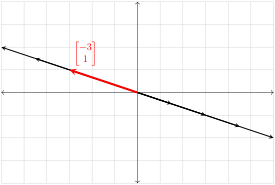
The span of \([-3,1]\) is the set of all linear combinations of \([-3,1]\text{.}\) Since we are looking for linear combinations of only one vector, we are really looking for all of its scalar multiples. So, the span will be the set of all vectors of the form \(\mathbf{v}=a[-3,1]\text{.}\) All such vectors lie on the line determined by \([-3,1]\text{.}\)
Vector and its span graphed

Example 2.2.16.

Describe
\begin{equation*} \text{span}\left(\begin{bmatrix}2\\2\end{bmatrix}, \begin{bmatrix}-1\\0\end{bmatrix}\right). \end{equation*}
Answer.
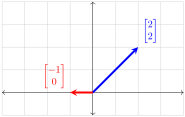
First, observe that \([2,2]\) and \([-1,0]\) are not scalar multiples of each other.
Two vectors graphed
Geometrically, we can use Exploration 2.2.1 to express any vector of \(\R^2\) as a linear combination of \([2,2]\) and \([-1,0]\text{,}\) indicating that the two vectors span all of \(\R^2\text{.}\)
To verify this claim algebraically we will show that an arbitrary vector \([s,t]\) of \(\R^2\) can be written as a linear combination of \([2,2]\) and \([-1,0]\text{.}\)
Consider the vector equation:
\begin{equation*} a_1\begin{bmatrix}2\\2\end{bmatrix}+a_2\begin{bmatrix}-1\\0\end{bmatrix}=\begin{bmatrix}s\\t\end{bmatrix}. \end{equation*}
This corresponds to the system:
\begin{equation*} \begin{array}{ccccc} 2a_1 \amp -\amp a_2\amp = \amp s \\ 2a_1\amp \amp \amp = \amp t \\ \end{array}. \end{equation*}
Writing the system in augmented matrix form and applying elementary row operations gives us the following reduced row-echelon form:
\begin{equation*} \left[\begin{array}{cc|c} 2\amp -1\amp s\\2\amp 0\amp t \end{array}\right]\rightsquigarrow\left[\begin{array}{cc|c} 1\amp 0\amp t/2\\0\amp 1\amp t-s \end{array}\right]. \end{equation*}
This shows that every vector of \(\R^2\) can be written as a linear combination of \([2,2]\) and \([-1,0]\text{:}\)
\begin{equation*} (t/2)\begin{bmatrix}2\\2\end{bmatrix}+(t-s)\begin{bmatrix}-1\\0\end{bmatrix}=\begin{bmatrix}s\\t\end{bmatrix}. \end{equation*}
We conclude that
\begin{equation*} \text{span}\left(\begin{bmatrix}2\\2\end{bmatrix}, \begin{bmatrix}-1\\0\end{bmatrix}\right)=\R^2. \end{equation*}

Example 2.2.17.

Describe
\begin{equation*} \text{span}\left(\begin{bmatrix}5\\0\\4\end{bmatrix}, \begin{bmatrix}0\\4\\2\end{bmatrix}\right). \end{equation*}
Answer.
First, observe that \([5,0,4], [0,4,2]\) are not scalar multiples of each other.
Two relevant vectors drawn
The span of \([5,0,4]\) and \([0,4,2]\) consists of elements of the form
\begin{equation*} a_1\begin{bmatrix}5\\0\\4\end{bmatrix}+a_2\begin{bmatrix}0\\4\\2\end{bmatrix}. \end{equation*}
Geometrically, we can interpret all such linear combinations as diagonals of parallelograms determined by scalar multiples of \([5,0,4]\) and \([0,4,2]\text{.}\) All such diagonals will lie in the plane determined by \([5,0,4]\) and \([0,4,2]\text{.}\) Let this plane be called \(p\text{.}\) A portion of \(p\) is shown below.
Span of previous two vectors drawn
Because Exploration 2.2.1 can be applied to vectors that lie in \(p\) just as easily as it can be applied to vectors of \(\R^2\text{,}\) we conclude that every vector in \(p\) can be expressed as a linear combination of \([5,0,4]\) and \([0,4,2]\text{.}\) Thus,
\begin{equation*} \text{span}\left(\begin{bmatrix}5\\0\\4\end{bmatrix}, \begin{bmatrix}0\\4\\2\end{bmatrix}\right)=p. \end{equation*}

Exercises 2.2.4 Exercises

1.

Solve a system of linear equations to express \([-1, 7]\) as a linear combination of \([1,2]\) and \([-1,1]\text{.}\)
Answer.
System of linear equations:
\begin{equation*} \begin{array}{ccccc} 1a \amp +\amp -1b\amp = \amp -1 \\ 2a\amp +\amp 1b\amp =\amp 7 \end{array}. \end{equation*}
Values of \(a\) and \(b\text{:}\)
\begin{equation*} a=2\quad\text{and}\quad b=3 \end{equation*}
Linear Combination:
\begin{equation*} \begin{bmatrix}-1\\7\end{bmatrix}=2\begin{bmatrix}1\\2\end{bmatrix}+3\begin{bmatrix}-1\\1\end{bmatrix}. \end{equation*}

2.

Use Exploration 2.2.3 to express \([-3, 0]\) as a linear combination of \([2,4]\) and \([-1, 1]\text{.}\)
Answer.
Linear Combination:
\begin{equation*} \begin{bmatrix}-3\\0\end{bmatrix}=-0.5\begin{bmatrix}2\\4\end{bmatrix}+2\begin{bmatrix}-1\\1\end{bmatrix}. \end{equation*}

3.

Use two different approaches (algebraic and geometric) to explain why the vector \([5,1]\) cannot be expressed as a linear combination of vectors \([2,-1]\) and \([-4,2]\text{.}\)

4.

Exploration 2.2.1 shows geometrically how to write one vector in \(\R^2\) as a linear combination of two others. The same process can, in certain cases be applied to vectors in \(\R^3\text{.}\) In both parts of this problem you will be asked to follow the steps in Exploration 2.2.1 to express one vector as a linear combination of two given vectors. Then you will be asked to identify the condition which makes it possible to do so.
The following GeoGebra interactive shows vectors \(u=[3,0,-1]\text{,}\) \(v=[1,-2,1]\) and \(w=[7,4,-5]\text{.}\) RIGHT-CLICK and DRAG to rotate the image.
Figure 2.2.18.

5.

Can \(\mathbf{w}\) be expressed as a linear combination of \(\mathbf{u}\) and \(\mathbf{v}\text{?}\)
  • No, because \(\mathbf{w}\) is not between \(\mathbf{u}\) and \(\mathbf{v}\)
    .
  • Yes, because all three vectors are in the same plane.
  • Yes, because all three vectors are in the same plane, AND \(\mathbf{u} \) and \(\mathbf{v}\) are not collinear.

6.

Use the navigation bar at the bottom of the interactive window to view the step-by=step construction of the linea combination of \(\mathbf{u}\text{,}\) \(\mathbf{v}\) that equals \(\mathbf{w}\) (right-click and drag to rotate the image). Use the final image to express \(w\) as a linear combination of \(v\) (blue) and \(u\) (red).
Answer.
\begin{equation*} w=-2v+3u \end{equation*}

7.

The following GeoGebra interactive shows vectors \(v=[1,-2,1]\text{,}\) \(u=[3,0,-1]\text{,}\) and \(w=[7,4,0]\text{.}\) RIGHT-CLICK and DRAG to rotate the image. Use geometry to explain why \(w\) cannot be expressed as a linear combination of \(v\) and \(u\text{.}\)
Figure 2.2.19.
Answer.
We can also show that \(w\) is not a linear combination of \(v\) and \(u\) algebraically by attempting to solve a system of equations corresponding to
\begin{equation*} x_1 v + x_2 u=w. \end{equation*}
Set up the system of equations
\begin{equation*} \begin{array}{ccccccc} 1x_1 \amp +\amp 3x_2\amp = \amp 7 \\ -2x_1\amp +\amp 0x_2\amp =\amp 4\\ 1x_1\amp +\amp -1x_2\amp =\amp 0 \end{array}. \end{equation*}
Find the reduced row echelon form.
\begin{equation*} \left[\begin{array}{cc|c} 1\amp 0\amp 0\\0\amp 1\amp 0\\0\amp 0\amp 1 \end{array}\right]. \end{equation*}

Exercise Group.

Choose the best description for each set below.
8.
\begin{equation*} \text{span}\left(\begin{bmatrix}1\\1\\-2\end{bmatrix}, \begin{bmatrix}2\\2\\-4\end{bmatrix}\right) \end{equation*}
  • Plane in \(\R^3\)
  • Line in \(\R^2\)
  • Line in \(\R^3\)
  • \(\R^3\)
  • \(\R^2\)
9.
\begin{equation*} \text{span}\left(\begin{bmatrix}1\\-2\end{bmatrix}, \begin{bmatrix}1\\0\end{bmatrix}\right) \end{equation*}
  • Plane in \(\R^3\)
  • Line in \(\R^2\)
  • Line in \(\R^3\)
  • \(\R^3\)
  • \(\R^2\)
10.
\begin{equation*} \text{span}\left(\begin{bmatrix}-3\\1\end{bmatrix}, \begin{bmatrix}6\\-2\end{bmatrix}, \begin{bmatrix}3\\-1\end{bmatrix}\right) \end{equation*}
  • Plane in \(\R^3\)
  • Line in \(\R^2\)
  • Line in \(\R^3\)
  • \(\R^3\)
  • \(\R^2\)

11.

Which of the following pairs of sets are equal?
  • \(V=\text{span}\left(\begin{bmatrix}5\\0\\0\end{bmatrix},\begin{bmatrix}10\\0\\0\end{bmatrix},\begin{bmatrix}0\\0\\-4\end{bmatrix}\right) \quad\text{and}\quad W=\text{span}\left(\begin{bmatrix}-2\\0\\0\end{bmatrix},\begin{bmatrix}0\\0\\1\end{bmatrix}\right)\)
  • \(V=\text{span}\left(\begin{bmatrix} 5\\ 3\end{bmatrix},\begin{bmatrix} 10\\ -1 \end{bmatrix},\begin{bmatrix} 0\\ 2 \end{bmatrix}\right) \quad\text{and}\quad W=\text{span}\left(\begin{bmatrix} -2\\ 0 \end{bmatrix},\begin{bmatrix} 0\\ 1\end{bmatrix}\right)\)
  • \(V=\text{span}\left(\begin{bmatrix}1\\-2\\4\end{bmatrix}\right)\quad\text{and}\quad W=\text{span}\left(\begin{bmatrix}-1\\2\\-4\end{bmatrix},\begin{bmatrix}0\\0\\1\end{bmatrix}\right)\)
  • \(V=\text{span}\left(\begin{bmatrix}5\\0\end{bmatrix}\right)\quad\text{and}\quad W=\text{span}\left(\begin{bmatrix}-2\\0\end{bmatrix},\begin{bmatrix}1\\0\end{bmatrix},\begin{bmatrix}-4\\0\end{bmatrix},\begin{bmatrix}0\\0\end{bmatrix}\right)\)

12.

Let \(\mathbf{v}=[3,4,5]\text{.}\) Give an example of at least one vector \(\mathbf{w}\) such that \(\mathbf{v}\text{,}\) \(\mathbf{w}\) do NOT span a plane in \(\R^3\text{.}\) Describe \(\text{span}(\mathbf{v}, \mathbf{w})\text{.}\)

13.

Prove or disprove. The zero vector of \(\R^n\) is contained in the span of any collection of vectors of \(\R^n\text{.}\)

